Showing posts sorted by date for query mayer. Sort by relevance Show all posts

Saturday, April 01, 2023

Learning Designers will have to adapt or die. 10 ways to UPSKILL to AI….

Interactive Designers will have to adapt or die. AI and Generative AI (not the same thing) has started to play a major part of the online learning landscape, right across the learning journey. it is now being used for learner engagement, syllabus planning, core skills identification, learner support, content creation, assessment and so on. It will eat relentlessly into the traditional skills that have been in play for nearly 35 years. The old, core skillset was writing, media production, interactions and assessment, all delivered through an authoring language. It remained unchanged for nearly 30 years. In many ways it got worse as the tools began to determine the content, so we got lots of cartoony content, with click on speech bubbles, clumsy, drag and drop, stock photos and MCQs. It was expensive and took months. 

Every online learning company on the planet is now having strategy meetings to face uo to the challenge.

This is not easy as many of those involved in traditional online content creation will find it difficult to adapt. Others, however, will embrace the change. Many will have to identify individuals with the skills and attitudes to deal with this new demand. This means understanding the new technology (not trivial), learning how to write for new dialogic tools, and dealing more with AI-aided design and curation, rather than doing this for themselves. It’s a radical shift.


In a Keynote over five years ago, I summarised this shift as follows...
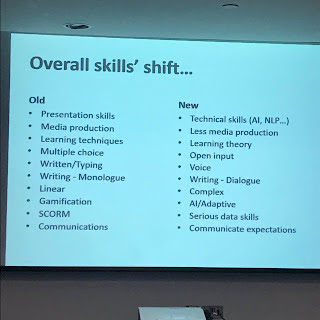


This is the new version…


In another context, using a tool like ChatGPT meant not using traditional interactive designers, as the software largely does this job. It identifies the learning points, automatically creates the interactions, finds the curated links and assesses, formatively and summatively. It creates content in minutes not months. This is the way online learning is going. I’m involved in several projects where Generative AI is appearing in real product. One was launched at BETT this week (Glean), others are on their way. This stuff is here, now.


The gear-shift in skills is interesting and, although still uncertain, here’s some suggestions based on my concrete experience of making and observing this shift in a number of different companies.


1. Technical understanding

Designers, IDs, LXDs, Learning Engineers or whatever they’re called now or in the future, will need to know far more about what the software does, its functionality, strengths and weaknesses. In some large projects we have found that a knowledge of how the NLP (Natural language Processing) works has been an invaluable skill, along with an ability to troubleshoot by diagnosing what the software can, or cannot do. Those with some technical understanding fare better here as they understand both the potential and limitations.


This is not to say that you need to be able to code or have pure AI or data science skills. It does mean that you will have to know, in detail, how the software works. If it uses semantic techniques, make the effort to understand the approach, along with its weaknesses and strengths. With ChatGPT, for example, you really do need to keep up with the speed of releases, ChatGPT came out in late Nov 2022, ChatGPT, an order of magnitude better came out in March 2023. I see far too many people still using and basing their opinions on ChatGPT3. Keep up or become irrelevant.


In a series of category errors, any of the silly clickbait 'look at what I've just done' screen shots don't really understand the underlying technology. most are from ChatGPT3, not 4, like using a version of Wikipedia from 2003. The fine tuning, RLHF and guardrailing is ignored, yet these are the things learning professionals need to know about the technology. This will take time. You always have to go through the clickbait phase to get to the serious comment and use cases. The good news is the amazing things people are doing with the tool, especially in learning.


Similarly with data analysis. With traditional online learning, the software largely delivers static pages with no real semantic understanding, adaptability or intelligence, hence the stickiness of SCORM. AI created content is very different and has a sort of  ‘life of its own’, especially when it uses machine learning. At the very least get to know what the major areas of AI are, how they work and feel comfortable with the vocabulary.


2. Writing

Text remains the core medium in online learning. It remains the core medium in online activity generally. We have seen the pendulum swing towards video, graphics and audio but text will remain a strong medium, as we read faster than we listen, it is editable and searchable. That is why much social media and messaging is still text at heart. When I ran a large traditional online learning company we regarded writing as the key skill for IDs. We put people through literacy tests before they started, no matter what qualifications they had. It proved to be a good predictor, as writing is not just about turn of phrase and style, it is really about communications, purpose, order, logic and structure. I was never a fan of ‘storytelling’ or ‘creativity’ as identifiable skills.


However, the sort of writing one has to do in the new world of AI has more to do with being sensitive to what generative AI does, and dialogue. Prompt writing is important and this is where experienced IDs and graphic artists can excel. Prompting is best done by domain experts. A good graphic artists will know how to ask for the right image in terms of style, fonts, look and feel, with all the right parameters. Similarly with good IDs, who will know how to prompt for great questions, not just fact checking. It is a matter of taking your skills and applying them to using these new tools and technologies.


3. Interaction

Hopefully we will see the reduction in the formulaic Multiple-Choice Question production. MCQs are difficult to write and often flawed. Then there is the often vicariously used ‘drag and drop’ and hideously patronising ‘Let’s see what Philip, Alisha and Sue think of this… ‘ you click on a face and get a speech bubble of text. I find that this is the area where most online learning really sucks. This, I think, will be an area of huge change as the limited forms of MCQ start to be replaced by open input; of words, numbers and short text answers. NLP allows us to interpret this text. There is also voice interaction to consider, which many will implement, so that the entire learning experience, all navigation and interaction, is voice-driven. This needs some extra skills in terms of managing expectations and dealing with the vagaries of speech recognition software. If you don’t know about Whisper, you should. Personalisation may also have to be considered. These tools are basically AI on tap. This software is far too complex to build on your own. Yet it makes smart implementation in scale possible.


4. Media production

As online learning became trapped in ‘media production’ most of the effort and budget went into the production of graphics (often illustrative and not meaningfully instructive), animation (often overworked) and video (not enough in itself). Media rich is not necessarily mind rich and the research from Nass, Reeves, Mayer and many others, shows that the excessive use of media can inhibit learning. Unfortunately, much of this research is ignored. We will see this change as the balance shifts towards effortful and more efficient learning. There will still be the need for good media production but it will lessen as AI becomes multimodal, creating text, images, audio and video, even 3D worlds. 


Video is never enough in learning and needs to be supplemented by other forms of active learning. AI can do this, making video an even stronger medium. Curation strategies are also important. We often produce content that is already there but AI helps automatically link to content or provides tools for curating content. Lastly, a word on design thinking. The danger is in seeing every learning experience as a uniquely designed thing, to be subjected to an expensive design thinking process, when design can be embodied in good interface design. We are now in the world of rapid design by smart software that has done a lot of the A/B testing on a gargantuan scale. These methods look more and more out of date.


5. Assessment

So many online learning courses have a fairly arbitrary 70-80% pass threshold. The assessments are rarely the result of any serious thought about the actual level of competence needed, and if you don’t assess the other 20-30% it may, in healthcare, for example, kill someone. There are many ways in which assessment will be aided by AI in terms of the push towards 100% competence, adaptive assessment, digital identification, open input, transfer, good generated rubrics and so on. This will be a feature of more adaptive and dialogue-driven AI driven content. Generative AI produces assessments at speed and with relevance to the competences. That was never the case in traditional online learning.


6. Data skills

SCORM is looking like an increasingly stupid limit on online learning. To be honest it was from its inception – I was there. Completion is useful but rarely enough. It is important to supplement SCORM with far more detailed data on user behaviours. But even when data is plentiful, it needs to be turned into information, visualised to make it useful. That is one set of skills that is useful, knowing how to visualise data. Information then has to be turned into knowledge and insights. This is where skills are often lacking. First you have to know the many different types of data in learning, how data sets are cleaned, then the techniques used to extract useful insights, often machine learning. You need to distinguish between data as the new oil and data as the new snake oil.


We take data, clean it, process it, then look for insights – clusters and other statistically significant techniques to find patterns and correlations. For example, do course completions correlate with an increase in sales in those retail outlets that complete the training? Training can then be seen as part of a business process where AI not only creates the learning but does the analysis and that is all in a virtual and virtuous loop that informs and improves the business. It is not that you require deep data scientist skills, but you need to become aware of the possibilities of data production, the danger of GIGO, garbage-in/garbage out and the techniques used in this area. AI is now a feature of data-centric learning solutions. Acquire some basic knowledge of data science, nothing fancy, just get to know the lie of the land.


7. User testing

In one major project , we produced so much content, so quickly, that the client had trouble keeping up on quality control at their end. We were making it faster than it could be tested! You will find that the QA process is very different, with quick access to the actual content, allowing for immediate testing. In fact, AI tends to produce less mistakes in my experience as there is less human input, always a source of spelling, punctuation and other errors. I used to ask graphic artists to always cut and paste text as it was a source of endless QA problems. The advantage of using AI generated content is that all sides can screen share to solve residual problems on the actual content seen by the learner. We completed one large project without a single face-to-face meeting. This quick production also opens up the possibility of quick testing with real learners. 


8. Learning theory - pedAIgogy

In my experience, few interactive designers can name many researchers or identify key pieces of research on, let's say the optimal number of options in a MCQ (answer at foot of this article), retrieval practice, length of video, effects of redundancy, spaced-practice theory, even the rudiments of how memory works (episodic v semantic). This is elementary stuff but it is rarely taken seriously. With AI you can build pedagogy, or what I call pedAIgogy, into the prompting and therefore learning experiences. We are doing precisely this on one product.


With the implementation of AI, the AI HAS to embody good pedagogic practice. Bill Gates recently published an excellent piece on Generative AI saying that learning will be it b] greatest benefit, but te piece was marred by him pushing ‘learning styles’. Greg Brokman, of Open AI, did te same retweeting a tool based on learning styles. We know better than this and can build good, well-researched, learning practice into the software. Hopefully, this will drive online learning away from long-winded projects that take months to complete, towards production that takes minutes not months, and learning experiences that focus on learning not appearance.


see PedAIgogy


9. Agile production

Communications with AI developers and data scientists is a challenge. They know a lot about the software but often little about learning and the goals. On the other hand designers know a lot about communications, learning and goals. Agile techniques, with a shared whiteboard, scrums and superfast production are useful. I love these. There are formal agile techniques around identifying the user story, extracting features then coming to agreed tasks. Comms are tougher in this world so learn to be forgiving. There will inevitable be friction between the old and the new. Treat that as a normal.


Then there’s communications with the client and SMEs. This can be particularly difficult, as some of the output is AI generated, and as AI is not remotely human (not conscious or cognitive) it can produce mistakes. The good news is that these are now rare. You learn to deal with this when you work in this field. To be honest, A=all of those learning folk telling me that AI shouldn't be used in learning, as it sometimes has an error or two, will happily use content with learning styles, Myers-Briggs, Bloom's pyramid, Maslow and no end of bogus theory and content in courses


This new approach is often not easy for clients to understand, as they will be used to design document, scripts and traditional QA techniques. I had AI once automatically produce a link for the word ‘blow’, a technique nurses ask of young patients when they’re using sharps or needles. The AI linked to the Wikipedia page for ‘blow’ – which was cocaine – easily remedied but odd. You have to be careful but that has always been te case. I can barely think of a single training project where the SME content was spot on.


The great news is that this all means we can reduce iterations with SMEs, even cut them out altogether, as the software often has more knowledge and can write it to any level or style. The cause of much of the high cost of online learning is expensive SMEs and endless iterations. If the AI is identifying learning points and curated content, using already approved documents, PPTs and videos, the need for SME input is lessened. This saves a ton of time and money.


10. Make the leap

AI is here. We are, at last, emerging from a 30 year paradigm of media production and multiple choice questions, in largely flat and unintelligent learning experiences, towards smart, intelligent online learning, that behaves more like a good teacher, where you are taught as an individual with a personalised experience, challenged and, rather than endlessly choosing from lists, engage in effortful learning, using dialogue, even voice. As a Learning designer, Interactive designer, Project Manager, Producer, whatever, this is the most exciting thing to have happened in the last 30 years of learning.
Most of the Interactive Designers I have known, worked with and hired over the last 30  plus years have been skilled people, sensitive to the needs of learners but we must always be willing to 'learn', for that is our vocation. To stop learning is to do learning a disservice. So make the leap!


Conclusion
In addition, those in HR and L and D will have to get to grips with AI. It will change the very nature of the workforce, which is our business. This means it will change WHY we learn WHAT we learn and HOW we learn. Almost all online experiences are now mediated by AI - Facebook, Twitter, Instagram, Amazon, Netflix.... except in learning! But that has just dramatically change. Generative AI heralds a new era, a renaissance oin learning, where we can learn anything, at anytime, anywhere using sophisticated AI tutors. What is needed is a change in mindset, as well as tools and skills. It may be difficult to adapt to this new world, where many aspects of design will be automated. I suspect that it will lead to a swing away from souped up graphic design back towards learning. That would will be a good thing.


Monday, December 13, 2021

Wittrock Generative learning

Merlin Wittrock (1931 - 2007) worked at the University of California and saw good learning as a generative process. In a series of papers over two decades he saw 'generative' learning as the key to creating a shift in education towards more efficient learning. 
It has its roots in Bartlett (1932) and Piaget (1926) who both saw learning as acts of construction and, for Piaget, fitting knowledge into existing schemas. But for Wittrock, generative learning theory was built on the idea of learners integrating new knowledge and skills into what they already know though generative activities, where effective teaching facilitates leavers to construct meaning from various generative experiences.

Generative theory of learning

Wittrock not only developed his generative theory of learning, he also researched its effectiveness and applied it in practice. Learners, for Wittrock, are not passive receivers of knowledge, they are active reorgansisers of knowledge, creating meaning from their own generative activities. His generative learning theory was built on the idea of learners integrating new knowledge and skills into what they already know through generative activities. Effective teaching must therefore facilitate learners to construct meaning from various generative experiences.

His model encourages learners to generate meaning and understanding from instruction through effortful, generative activities and has four major processes:

(a) attention - directing generative processes on relevant incoming material and stored knowledge

(b) motivation - willingness to invest effort to make sense of material

(c) knowledge and preconceptions - prior knowledge, experiences, and beliefs

(d) generation - sense making

For Wittrock all four have generative components, what some would describe as constructive, where the learners control and build their own models, rather than interpreting taught content. Teachers must therefore learn to lead learners towards learning by encouraging generative activities. 

Generative activities

The generation of notes in one’s own words, use of analogies and effortful activities are all generative. Summaries and analogies in reading, for example, is an effective learning strategy, Wittrock & Alesandrini (1990). 

Fiorella & Mayer (2015) recommend eight types of generative strategies:

Summarizing: Create a written or oral summary of the material 

Mapping: Create a concept map, knowledge map or matrix organizer 

Drawing: Create a drawing that depicts the text

Imagining: Imagine a drawing that depicts the text 

Self-testing: Give yourself a practice test on the material 

Self-explaining Create a written or oral explanation of the material 

Teaching: Explain the material to others 

Enacting: Move objects to act out the material

Problem solving

With Richard Mayer, Wittrock also contributed to research on problem solving in order to identify the best way to teach it, with three main findings:


  1. Domain-specific principle - teach problem as a domain specific skill not as a general skill

  2. Near transfer principle - accept that problem solving skills work across a limited range of applicability

  3. Knowledge integration principle - use guided problem-solving tasks to teach knowledge


Wittorck was heavily involved in teacher training and his generative theory was not just about what the learner did, it was also about appropriately generative teaching strategies. Problem solving was one such strategy.

Critique

Generative learning has been criticised by some as swinging the instructional pendulum too far towards discovery or exploratory learning, diminishing the role of direct instruction. Its singular focus on the generative processes, some think are partial, with other processes involved in learning.

Influence

Wittrock’s work on generative learning has not had as much influence as the topic and his work deserve. As technology has developed and social media normalised, the creation of text, images and videos have become common online, generative activities.

Bibliography

Wittrock, M.C., 1992. Generative learning processes of the brain. Educational Psychologist, 27(4), pp.531-541.

Wittrock, M.C., 1989. Generative processes of comprehension. Educational psychologist, 24(4), pp.345-376.

Wittrock, M.C., 1974. Learning as a generative process. Educational psychologist, 11(2), pp.87-95.

Fiorella, L. and Mayer, R.E., 2016. Eight ways to promote generative learning. Educational Psychology Review, 28(4), pp.717-741.

Wittrock, M.C. and Alesandrini, K., 1990. Generation of summaries and analogies and analytic and holistic abilities. American Educational Research Journal, 27(3), pp.489-502.

Mayer, R.E., 2010. Merlin C. Wittrock's enduring contributions to the science of learning. Educational Psychologist, 45(1), pp.46-50.

Mayer, R.E. and Wittrock, M.C., 2006. Problem Solving In P. Alexander, P. Winne, & G. Phye.


Sunday, November 14, 2021

Krug Don't make us think

Steve Krug has a background in writing computer manuals. He saw that this was not the solution to most problems and moved on into usability design. He has had a huge influence on web design through his best-selling book Don’t Make Me Think (2000). He also provided a method for quick and effective testing in his second book Rocket Surgery Made Easy (2009). The huge success of these books meant that user interface design was taken more seriously in terms of good practice and the need for testing with real users. Interface design, or UX design, has gained importance as part of general online learning design.

Interface design

Krug asks a simple question, ‘How do we really use the web?’ We glance, scan and muddle through. We don’t read pages, we scan them, choose the first reasonable option, and because we’re lazy, we meander through content. This is important and, if excesses in design are to be avoided, it has to be understood when designing web sites and online learning. His theory is based on real practice and positive results on real web sites. Krug’s first law of usability is to strive to make things self-evident or self-explanatory, hence the title ‘Don’t Make Me Think’.

Users and learners want the interface to be an unthinking act, easy and unobtrusive. The more they think, the more likely they are to stop and go elsewhere. Forget instructions. People don’t read them and don’t want them. He recommends that we design out the need for a tutorial or instructions.

Design recommendations

Sensitive to the needs of the internet as a medium in itself, he emphasises the importance of the Home page. This leads to reflection on the importance of the ‘Big Picture’, namely the essential purpose of the site or online learning programme. He recommends tag lines that capture the essence of a site or web experience. Mission statements he hates, as they rarely tell you the real story and usually miss the Big Picture. 

Navigation hierarchies

Taking his lead from newspapers, always an interesting source for screen design, he recommends carefully designed hierarchies. He hates navigation that breaks down when you get past the second level. The solution, he thinks, is persistent global navigation at the same position on every page with a home button and tracking. He loves fixed menus. He also makes the useful distinction between navigation, utilities (print, search and so on) and content. It is always a payoff between ‘wide and deep’ hierarchies. 

Be conventional

Following on from Norman and Nielsen, he stresses conventions. Don’t play fast and loose, make things easy and consistent. Use conventions, such as shopping carts, standard video controls and icons. This is sound advice. Conventions are more than just objects of convenience, they are part of the grammar of interface design. Designers often refuse to use conventions as they crave creativity and innovation – this, in his view, is rarely useful. Pages should also be broken up into carefully defined areas, clickable areas should be obvious and every attempt made to minimise ‘noise’, again a Mayer and Clark principle in online learning.

Half the number of words and half again

True to his belief that screen readers are different from readers of print, he has strong views on writing for the screen. Less is more and so he exhorts designers and writers to omit needless words. In his own words, “Half the number of words and half again”. 

Search

Krug was among the earliest evangelists for search on websites. Search is a window into the collective mind of your users. It tells you what people really want, look for and what is most likely missing.

Interface design in online learning

In interface design, as Steve Krug says in the title, the point is NOT to make people think. In learning, the whole point is to make people think. Yet many of his recommendations are applicable across learning experiences. His advice on drastically reducing text has been confirmed in research by Mayer and others in online learning design. The importance of search has also come to the fore in Learning Experience Platforms used for learning in the workflow.

Krug’s prescriptions are even more important in online learning than in web design, as learning’s great enemy is cognitive overload and dissonance. If learners have to work hard to understand, navigate and read online learning, they have less sustained attention for retentive learning. Most online learning, like most offline learning, is too long winded and needs to be seriously edited to avoid cognitive overload. Keep navigation simple and consistent, use de facto conventions, avoid deep hierarchies and write for the screen not the page. And don’t forget to test – a few iterations with experts.

Usability testing

His second book Rocket Surgery Made Easy, shows how to do modest, low budget testing. His starting point is that designers can’t see the mistakes they make as they get too close to the design and as the navigation has come from their own heads, they lack objectivity. You need other fingers and eyeballs, guided by experts, using voiced testimonies. 

Krug, like Norman and Nielsen, is a strong believer in a specific form of usability testing. Following Nielsen and Landauer he takes the view that a few good, experienced testers and a few iterations are all you need. Forget the large-scale focus groups and massive testing, which suffer from the law of diminishing returns. His practical experience shows that just one, or a few testers early on are more effective than a large number at the end. 

He recommends evidence gathering with a camcorder and facilitator who asks questions and gives tasks, especially ‘Get it’ tasks where you probe the user for their understanding of the point of the experience, how it works and how it is organised. The point of the facilitator is to probe and ask them not only what they’re looking at but what they’re thinking. Listen, keep an open mind and take lots of notes.

An underlying point, made many years before by Dewey and Heidegger is that technologies work best when they hide themselves in things and tasks. Technology is at its best when it is invisible. This is the consistent theme in all good usability theorists and practitioners. The task of the designer, to make the delivery mechanism as invisible as possible.

Krug understands the different roles of specialists in design teams and the tensions that arise between them. His solution is to objectify the debate through testing, not with the mythical average user, but with real users. His is a useful, practical and prescriptive approach to good usability through good design.

Influence

Krug’s Don’t Make Me Think has sold over 600,000 copies. Rather than depend on academic literature, this popular book, in a sense he practices what he preaches. It is readable and does exactly what the user expects, give concrete advice on design and testing. As user design has grown as a practice Krug’s work is still relevant for its lasting recommendations.

Bibliography

Krug, S., 2009. Rocket surgery made easy: The do-it-yourself guide to finding and fixing usability problems. New Riders.

Krug, S., 2000. Don't make me think!: a common sense approach to Web usability. New Riders.


Thursday, November 11, 2021

Clark - Learning science to practice

From a scientific background, Ruth Colvin Clark bridges learning science into practice in workplace learning. Her collaboration with Richard Mayer on e-Learning and the Science of Instruction (2002) is a landmark text in technology based learning design. She has written many other books under her own authorship. As an instructional psychologist her book Evidence Based Training Methods (2019) provides practical guidelines, especially for adult learning practitioners.

Evidence-based practice

Empirical, evidence-based medicine in the 1990s influenced the emergence of evidence based learning in training. However, there are still relatively few with an evidence-based background in the training profession and few have the time to scan the research. Ruth Clark therefore scans and disseminates the evidence in the form of good practice. She stresses that research evolves and that we should keep on top of recent findings. Above all she recommends that we appreciate the strengths and weaknesses of working and long-term memory. Much of what we know about learning that can be applied in design and practice comes down to an understanding of these channels. All media have strengths and weaknesses and she is in favour of ‘Blended learning’.  

In Developing Technical Training (1999), she follows a traditional taxonomy of learning to present what she considers the best training methods or learning environments.

Principles for design

With Mayer she sets out some underlying principles for guiding online learning design:

Coherence Principle

Well researched, it is always tempting to elaborate learning experiences such as overworked and illustrative graphics, also over-engineered or tangential stories. Design for what do people ‘need to know’ as opposed to what is ‘desirable to know’. Review, edit and cut down content, as most learners have limited time. In other words, avoid irrelevant graphics, stories or excessively lengthy text.

Segmenting Principle

Shorter topics and content are usually preferable.With experienced learners you need to chunk less but with novice learners and learners new to the content, chunk, use white space, bullet points, build your graphic step by step. Keep things as short as possible. This chunking also gives a sense of achievement in learning, a series of accomplishments. Start with a very short title or outline, this helps.

Graphics for learning

Graphics for learning: Proven guidelines for planning, designing, and evaluating visuals in training materials (2010) is an evidence-based approach to the use of graphics in learning, whether in print, slides or online learning. She discusses the most appropriate graphic approach by matching it to the type of learning and integrating graphics into the overall learning experience. Picking up on the principles of contiguity, coherence and redundancy, her advice is specific on text and graphics being better than text alone, but one can overcook graphics and using them to fill up space and eye candy is not advisable. A graphic is often explained by text and/or audio. Do NOT narrate screen text as it causes confusion and you can read a lot faster than a narrator.

Scenario-based learning

In her book Scenario-based e-learning: Evidence-based guidelines for online workforce learning (2012) she explains why scenario-based learning works for certain types of learning and can increase expertise, problem solving, critical thinking and transfer. She gives practical advice on its benefits, when to use this design method, how to set the goals, consider the types of learning needed, think about being task centered, then evaluate, even make a business case for scenario-based learning.

Critique

Clark is loyal to the research in cognitive science and instruction but some argue that her approach is still firmly in the formal learning camp, ignoring the fact that most learning takes place in other contexts, through more informal forms of learning.

Influence

With her co-author Richard Mayer, she has contributed greatly to the dissemination of evidence-based design of learning experiences. However, her focus has been more on the practical application of the science of learning and evidence for good practice as applied in the actual design process.

Bibliography

Clark, R.C., 2019. Evidence-based training methods: A guide for training professionals. American Society for Training and Development.

Clark, R.C. Harnessing the virtual classroom. (2012) Training & Development, 59 (11), 41-45. Available for download at www.Clarktraining.com 

Clark, R.C. and Mayer, R.E., 2012. Scenario-based e-learning: Evidence-based guidelines for online workforce learning. John Wiley & Sons.

Clark, R.C. and Lyons, C., 2010. Graphics for learning: Proven guidelines for planning, designing, and evaluating visuals in training materials. John Wiley & Sons.

Clark, R.C. and Mayer, R.E. (2002). E-Learning and the Science of Instruction: Proven Guidelines for Consumers and Designers of Multimedia Learning. San Francisco: Jossey-Bass Pfeiffer. 

Clark, R.C. (1999). Developing Technical Training: A Structured Approach for Developing Classroom and Computer-Based Instructional Materials. Silver Spring, MD: International Society for Performance Improvement.


Saturday, October 02, 2021

Clark - Media, direct instruction, analysis, agents, games and AI in learning

Richard E. Clark is Professor Emeritus of Educational Psychology and Technology at the University of South California. He has produced a huge corpus of research and writing on technology and workplace learning and has put in a huge effort to bridge the gap between known theory, its boundaries, and practice. With a focus on instruction and not media, he has produced valuable work on performance gaps and how to do a thorough analysis using Cognitive Gap Analysis, to determine optimal training. His interest in learning technology has led to conclusions on everything from visual agents to games, in learning. He is also an advocate for the use of AI in training.

Learning from media

Clark asks us not to confuse methods of instruction with media and famously claimed 

in Clark (1983), considering research on learning from media, that there is no significant difference, in terms of benefits, between using different media to deliver instruction. His argument is that non-media methods, for example, instructional methods, different content, or assessment plans can be presented by any medium including teachers. What he does say is that different media can affect the number and variety of students who can access learning and, of course, that some media are more scalable and cost-effective than others (Clark, 2012).

Direct Instruction versus Constructivism

Evidence from learning theory, in particular the limitations of working memory, suggest that direct instruction may be more effective than unguided or lightly guided learning experiences. Guidance can be tapered off as learners gain competence and expertise. This is a direct challenge to the constructivist approach recommended by Bruner and Papert, that learners must discover or construct essential information for themselves. While the constructivist ‘description of learning’ may be accurate, the research shows Kirschner, Sweller, & Clark (2006) that the instructional methods recommended by constructivists are flawed.

Cognitive Task Analysis

In Turning Research Into Results: A guide to selecting the right performance solutions (2012) Clark focuses on the diagnosis of performance gaps in terms of; Knowledge and skills, Motivational and Organisational gaps. He then separates the use of  Job aids from Training and then Education. 

The solution, he recommends, is Cognitive Task Analysis (CTA), which is a front-end process to improve design. He sees this as the weakest part of most current analysis models. Research has found that experts are often unaware of what they actually do, as around 70% is executed automatically, without much self-awareness or reflection. The job of the learning designer is to uncover that 70%.

He starts with the selection of experts. You need experts who have been doing this for a while with proven success, who are not just trainers. 

  1. Interviewing experts, focus on sequence and tasks, the action (physical) and decision steps (psychological). Listening matters here. Get transcripts of these interviews. An important extra is to ask where trainees have difficulties. Where do they get stuck? 

  2. Edit transcripts to get descriptions that are meaningful to trainers.

  3. Interview experts (3-4) separately, and ask each what they think was missed.

  4. Go back to 1 say what 2 & 3 said and ask them to agree on one version.

  5. Collapse separate versions into one final version.

  6. Collect information about equipment, standards and examples from experts.

Motivation

His emphasis on motivation has always been a strong characteristic of his work. Motivation is not just what people need to learn, it can also be negative or harmful. People, for example, are often overconfident and reject advice. He sees four critical motivational features: 

  1. Values mismatch (for what they’re doing) that are meaningful to them. There’s huge variation. 

  2. Lack of self-confidence or self-efficacy.

  3. Disruptive emotions - being anxious, angry, depressed, negative, all stop people from learning

  4. Barriers that knock people, negative evaluations, attribution failures

Animated agents

Clark (2005) doubts that virtual, animated agents add any value in learning as the research shows a mix of results from well-designed studies. While guidance and attention may be focussed by agents they can also distract and place extra cognitive load on learners. Research is required that compares agents and non-agents in same designed learning experiences.

Games for learning

Clark sees no clear definition of what constitutes a ‘game’ and the research as insubstantial. Previous meta analyses of games have failed to include unpublished studies containing no significant gain results, which is what he believes is the most likely outcome in a well designed study. Games that use the discovery method of learning are, he claims, less effective than fully guided instruction for novice to intermediate learners and he thinks that the learning benefits, when found in games, are the product of instructional methods that can be presented, without the extra design and costs, in non-game contexts. They are a distraction from real, evidence-based instructional methods. In fact, games may result in less mental effort invested in learning because of the belief that they make learning ‘easier’. He concludes that less expensive instructional designs may be preferable and that increased motivation in games may actually hinder learning. He is also sceptical about the emphasis put on social learning and their implementation in chat rooms.

AI and learning

Clark is using AI to automate the CTA process and believes that all of training and development will, at some time, become AI supported. This will decrease the cost of front-end analysis and design, forcing it to become more evidence-based, free from biases and overcome the resistance that human beings bring to the table. This will, in his words “be a revolution”.

Influence

With MAyer, Clark has a reputation for rigorous adherence to research and evidence, providing guidance for practitioners in the design of learning experiences. Although online learning is often still blind to research-driven practices, Clark remains a rich and deep resource for professionals in the field.

Bibliography

Clark, R. E. (2012) Learning from media: Arguments, analysis and evidence, second edition. Greenwich Conn: Information Age Publishing.

Clark, R. E. (2011). Games for Instruction?. Presentation at the American Educational Research Association, New Orleans, LA

Clark, R. E. (May-June 2007) Learning from serious games? Arguments, evidence and research suggestions.  Educational Technology.  56 – 59

Clark, R. E. and Choi, S. (2005). Five design principles for experiments on the effects of animated pedagogical agents.  Journal of Educational Computing Research. 32(3). 209-225.

Sweller, J., Kirschner, P. A., & Clark, R. E. (2007). Why minimally guided teaching techniques do not work: A reply to commentaries. Educational Psychologist, 42(2), 115-121

Kirschner, P. A., Sweller, J., & Clark, R. E. (2006). Why minimal guidance during instruction does not work: An analysis of the failure of constructivist, discovery, problem-based experiential and inquiry-based teaching. Educational Psychologist, 41(2), 75-86

Elen, J., Clark, R.E. and Lowick, J., 2006. Handling complexity in learning environments: Research and theory. In : (p. 283e297). Oxford: Elsevier.

Clark, R.E. ed., 2001. Learning from media: Arguments, analysis, and evidence. IAP.

Clark, R. E. (1983) Reconsidering research on learning from media., Review of Educational Research, 53(4), 445-459