Showing posts sorted by relevance for query altman. Sort by date Show all posts

Wednesday, March 13, 2024

The Strange Case of Altman V Board at OpenAI revealed

The New Yorker article on the drama at OpenAI has uncovered, not only the timeline but the dynamics of the drama. It was a plot worthy of an episode in Succession. Kendall Roy is Sam Altman, a charismatic, persuasive and experienced tech entrepreneur. Logan Roy is Microsoft, looking to get some zest into the business, as it has lost its mojo. Then there are the bit players, the winners and losers. 

Helen Toner, was the 'Effective Altruism' academic, with no real AI or technical experience, who had to apologise to the board for writing opinion piece articles criticising the organisation in which she was a board member. She apologised but Altman clearly had no time for her antics. He tried to get her ousted from the Board, playing them off against each other. It happens – I’ve seen it. Some on the board were inexperienced in business and couldn’t cope with the pressure, clearly tangled up in academic debates about AGI, an insider said “Every step we get closer to A.G.I., everybody takes on, like, ten insanity points.” The board felt threatened, panicked and sacked Altman. BIG MISTAKE

Establishing that there was “no malfeasance” Microsoft went apeshit, Altman took Brockman with him, the staff revolted in favour of Altman. This was a battle between lightweight academics and experienced AI and business brains. Used to ruling the roost in the their world, and with more than a little of the arrogance that comes with academic status, they completely misjudged the situation and overplayed their hand. In the end it was a rout. The board “agreed to leave” (cough), Altman was reinstated, and the usual inquiry was ordered (always a sop). As one tech journalist noted "A clod of a board stays consistent to its cloddery.”

Two other fascinating characters in all this are Kevin Scott, the Microsoft AI guy, and Mira Murati, the ex-Tesla Albanian, tech savvy  and known to be unflappable. They both came from tough, poor backgrounds and hold the belief that this tech really is a leveller - we'll see. They steered all of this to its conclusion. 

The board all went, apart from Adam D’Angelo, co-founder and CEO of Quora. A computer scientist and hugely successful entrepreneur.

Larry Summers was brought in. Fascinating choice, ex-academic, president of Harvard but sacked during an early salvo in the culture wars and now soaked in economics, politics and business. He’s one of the best connected figures in America.  


The board has also been considerably expanded with a range of professional expertise; 
Bret Taylor is the Chair, a real heavyweight:
Creator of Google Maps
CTO at Facebook
Chair of Twitter
Co-CEO at Salesforce. 


He has brought in:
Sue Desmond -Hellman Former CEO of Gates Foundation, physician and experienced corporate board member
Nicole Seligman heavyweight global lawyer
Fidji Simo and other tech entrepreneur 
....and, of course, the King is dead Long live the King!
.....Samuel Altman.

One figure lurks behind all of this, the genius that is Ilya Sutskever. He knows more about AI than anyone there and created the software yet survives as he IS OpenAI. Like the mad-genius Oracle, sitting quietly in the middle watching all of this, above all of these petty squabbles. He is now back to his day job – changing the world. 


PS
Thanks to Peter Shea for helping me with this piece.

also original article - well worth a read but paywalled 
https://www.newyorker.com/magazine/2023/12/11/the-inside-story-of-microsofts-partnership-with-openai?fbclid=IwAR2kmNi0LLc3FaXY6s2C08YCaDS88hD4mBFauylAIJCgzJ4lBnHqyZ-ts6Y

Sunday, April 02, 2023

Ethics, Experts and AI

Ethics of AI has been discussed for decades. Even before Generative AI hit the world, the level of debate, from the philosophical to regulatory - was intense and at a high level. It has got even more intense over the last few months.

It is an area that demands high end thinking in complex philosophical, technical and regulatory domains. In short, it needs expertise. In public domain, the spate of Lex Friedman podcasts have been excellent - the recent Altman and Yudkoswsky ChatGPT programmes, in particular, represent the two ends of the spectrum. I also recommend high-end AI experts, such as Marcus, Brown, Hassabis, Karpathy, Lenat, Zaremba, Brockman and Tegman. At the philosophical level, Chalmers, Floridi, Bostrom, Russell, Larson, and no end of real experts have published good work in this field. They are now always easy to read but are worth the effort if you want to enter the debate. As you can imagine there is a wide spectrum from the super-optimists to catastrophic pessimists and everything in between. However, AI experts tend to be very smart and very academic, therefore often capable of justifying and taking very certain moral positions, even extremes, overdosing on their own certainty. 


Debate in the culture

In popular culture dozens of movies from Metropolis onwards have tacked the issues of mind and machine, more recently the excellent Her and ex machina, along many series, such as Black Mirror have covered many of the moral dilemmas. Harari covers an issue in Homo Deus and here's no end of books, some academic, some more readable and some pot-boilers. No one can say this topic has received no attention.


Catastrophists

At one end there are the catastrophists like Yudkoswsky, Leahy and Musk clustered around the famous Open Letter. The people behind the letter, the Future of Life Institute, have an ax to grind and couldn't even get the letter right, as it had fake names and some have backtracked. There is also something odd about a self-selecting group claiming that we are all stupid and easily manipulated, whereas they are enlightened and will fix it, then release to to use on their say so.


Pessimists

It is hard to align the catastrophists with the pessimists, like Noam Chomsky, who basically says, 'nothing to see here, move on'. There have been harbingers, not of doom but disinterest in LLMs, as they thought they would produce little that was useful. We can, I think, safely say they were wrong. They may well be right on such models reaching limits of functionality but in tandem with other tools they are here to stay.


Pragmatists

Then there’s a long tail of pragmatists, with varying levels of concern, from Larson, Hinton (his vision of an alternative Mortal Computer is worth listening to), as is Sam Altman and Yann LeCun, who thinks the open letter is a regressive, knee-jerk reaction, akin to previous censorious attitudes in history towards technology. Everyone of any worth or background in the field rightly sees problems, that is true of ant technology, which is always a double -edged sword. Unlike the catastrophists I have yet to read an unconditional optimists, who sees absolutely no problems here. In education, for example.some big hitters, such as Bill Gates and Salman Khan have put their shoulders into the task of realising the he benefits this technology has in learning.


Regulatory bodies

Further good news is that the regulatory bodies publish both their thinking and results and they have been, on the whole, deep, reasoned and careful. Rushed legislation that is too rigid does not respond well to new advances and can cripple innovation and I think they have been progressing well. I have written about this separately but the US, UK, EU and China, all in their different ways have something to offer and international alignment seems to be emerging.


My pragmatist view

I am aligned with LeCun and Altman on this and sit in the middle.The technology changes quickly and as it changes I take a dynamic view of these problems, a Bayesian view if you will, revising my view in the light of new approaches, models, data and problems as they arise. This was after a lot of reading, listening and the completion of my books on ‘AI for Learning’ where I looked at a suite of ethical issues, then ‘Learning Technologies’ where I wrote in depth about the features of new technologies such as writing, printing, computers, the internet and AI, including their cultural impact and the tendency for counter-reformations. One can see how all of these were met with opposition, even calls to be banned, certainly censored. I have lived through moral panics on calculators, computers, the internet, Wikipedia, social media, computer games and smartphones. There is always a ‘ban it’ movement.

Alignment

I’d rather take my time, as scalable alignment is the real issue. It is not as if there is one single, universal set of social norms and values to align to. Everybody's in an echo chamber says the people who think they're not. Alignment is therefore tricky, and needs software fixes (guardrails), human training of models and moderation. It may even need adjustments for different cultural contexts.


This is a control issue and we control the design and delivery of these systems, their high-level functions, representations and data. The only thing we don’t control is the optimization. That’s why there is no chance, for now, that these systems will destroy our civilization. As Lecun said “Some folks say "I'm scared of AGI. Are they scared of flying? No! Not because airplanes can't crash. But because engineers have made airliners very safe. Why would AI be any different? Why should AI engineers be more scared of AI than aircraft engineers were scared of flying?" The point is that we have successfully regulated, worldwide, carsbanking, pharma, encryption, the internet. We should look at this sector by sector. The one that does worry me is the military.

Escape

The big argument is that, without stopping it now, AGIs could learn to pursue goals which are undesirable (i.e. misaligned) from our human goals. They may, for example,  literally escape out onto the internet and autonomously cause chaos and real harm. I have seen no evidence that this is true, although the arguments are complex and I could be convinced. The emphasis in Generative AI into switch from pure moderation, the game of swatting issues as they arise, to training through RLHF (Reinforcement Learning through Human Feedback). This makes sense.


Ghosts in the machine

I’m wary of people soaked in a sci-fi culture, or more recently a censorious culture, coming up with non-falsifiable dystopian arguments, suggestions and visions that have no basis in reality. It is easy to project ideas into the depths of a layered neural network but much of the that projection is of ghosts in the machine. I’m also wary of those who are activists, not practitioners with an anti-tech agenda and who don’t really do ethics, in the sense of weighing up the benefits and downsides, but want to focus entirely on the downsides. I’m also wary of people bandying around general hypotheses on misinformation, alignment and bias, without much in the way of empirical data or definitions.


In fact, the signs so far on ChatGPT4 are that is has the potential to do great good. Sure you could, like Italy ban it, and allow the EU, despite its enormous spend on research, to fall further behind as investors freeze all investment across the EU. I’m with Bill Gates when he says the benefits could be global, with learning the No 1 application. In a world where there are often poorly trained teachers with classes of up to 50 children and places where there is one Doctor for every 10,000 people, the applications are obvious. This negativity over generative AI could do a lot of harm and have bad economic consequences. So let's not stop it for six months and not look at those opportunities.


Bibliography

The Oxford handbook of ethics of AI by Dubber, M. D., Pasquale, F., & Das, S. 

Ethics of artificial intelligence by Matthew S. Liao

AI Narratives: A history of imaginative thinking about intelligent machines by Stephen Cave, Kanta Dihal, & Sarah Dillon 

Human Compatible by Stuart Russell

Re-Engineering Humanity by Brett Frischmann and Evan Selinger

Robot Ethics 2.0: From Autonomous Cars to Artificial Intelligence by Patrick Lin, Keith Abney, and George A. Bekey

Artificial Intelligence Safety and Security edited by Roman V. Yampolskiy

Robot Rights by David J. Gunkel

Artificial Intelligence and Ethics: A Critical Edition" by Heinz D. Kurz and Mark J. Hauser

Moral Machines: Teaching Robots Right from Wrong by Wendell Wallach and Colin Allen

Artificial Intelligence and the Future of Power: 5 Battlegrounds" by Rajiv Malhotra

The Age of Surveillance Capitalism: The Fight for a Human Future at the New Frontier of Power by Shoshana Zuboff

AI Ethics by Mark Coeckelbergh


Wednesday, July 28, 2021

Curious story of the first Teaching Machines... did Skinner really rear his daughter in a box?

Mention Skinner and people will tell you of how he put his daughter in a box, reared her with stimuli for food and that she then sued him, suffered from mental illness and eventually committed suicide. None of this is true and when Lauren Slater wrote a book, Opening Skinner's Box, claiming it was, Deborah Skinner, his actual daughter, an artist who lives in England, wrote a scathing article in The Guardian saying it was all hogwash. Every few years a book of this sort pops out, from people who want to make exaggerated claims about the malign influence of technology in learning.

In fact, Skinner's Box was actually the device in which he trained rats and pigeons. Some critics mistake this for the air-conditioned crib Skinner designed, designed to keep a child warm. It had nothing to do with teaching or learning. Quite another of Skinner's activities were his 'Teaching Machines'. These also arouse strong reactions. Yet they were a product of their time, simply mechanical and actually quite ingenious, as they did what few instructional designers do today and that's accept open input by the learner. They were not the first, that was Pressey decades earlier, with his multiple choice questions.

Teaching machines didn’t appear in a vacuum. These were serious psychologists who based their designs on deeply held beliefs about learning theory. They were created, unsurprisingly, during the behaviourist era, by quirky academics with strong views. It was also a period of technological and mass manufacturing. Yet, oddly, the educational system and manufacturers remained stubbornly immune to their charm. So, despite all the fuss, nothing really happened on scale and few who work in technology for learning see these machines as having had real influence on their work. Nevertheless, it is a fascinating period and one from which we can learn.

19th Century Precursors

Automona had been written about since the Greeks and then actually produced, for centuries, by the Byzantines, Arabs and Europeans, creating highly imaginative, essentially mechanical, clockwork devices that performed fixed choreographed movements and tasks. 


But it wasn’t until the 19th century that mechanical devices were patented for teaching and learning. Mellan (1936) uncovered hundreds of these patents, although most were hand-cranked devices that offered little in the way of feedback. The first that was automated, was in 1866 by Halycom Skinner (no relation to BJ Skinner), for an automated spelling teaching machine. It fell short of giving feedback but was credible in terms of teaching. George Altman was another who had a scrolling device for teaching arithmetic patented in 1897, then Aikins in 1911 obtained a patent for a spelling machine that made you match letters to a shown object, which actually mentions the psychologist Thorndike as a justification for its efficacy. This late Victorian era was looking for industrial solutions to make mass schooling more efficient. None were actually manufactured and sold on scale.

Pressy

The true origin of teaching machines was the relatively unknown figure of Sidney Pressey, who came up with his idea for a teaching machine in 1915. He had to shelve the idea, as the First World War intervened, until he finally filed a patent in 1926. This was the first known machine to deliver content, accept input and deliver feedback. He is therefore the true originator of the first teaching machine.


Pressey was a cognitive psychologist long before it was seen as a school of psychology. He refused to accept learning theory based on the reductionist behaviourism of animal psychologists such as Pavlov, the behaviourist evangelist Watson or Skinner, who he knew personally, and had little time for learning theory that excluded consciousness, language and mental phenomena. The claim, therefore, that Teaching Machines were based on crude behaviourism, is simply false. His teaching machines reflected his cognitive-based learning theory.


His first machine used old typewriter parts to present multiple-choice questions with four options. The learner pressed a key for the right answer and the results were stored on a counter. It had the three necessary conditions for a teaching machine, the presentation of content, input by users and feedback. 


His second machine had the innovation of not moving on until you got the right answer and he continued to innovate with teaching machines into the late 1950s. Pressey understood that such machines could be used for both teaching and testing. You could set the machine, using a simple lever, to only move on if the learner got the right answer or alternatively assess by recording all of their answers, right and wrong. 

Using the second machine was easy, the learner simply pressed one of five keys (1-5), it had a small window that showed the numbers of questions asked and a window on the side showing the number of questions they got correct. In teaching mode the learners had to continue until the correct answer was chosen and the next question appeared. The questions number did not change until it was answered correctly and the window on the side showed the number of tries. He argued that this was quick, gave immediate results so that the learner didn’t have to wait days for results and saved the teacher time from the drudgery of marking, also eliminating marking errors. He also argued that this could free teachers to teach in a more inspirational manner. The learner could also repeat the experience until they got full mastery. You could quickly reset for the next student in seconds or the next test and could cope with up to 100 questions. These arguments are sound. An interesting attachment to the main machine delivered a candy if you passed a threshold number of correct answers (the threshold could be changed on the machine via a dial). All for under $15. Unfortunately, his timing was bad and the Great Depression put an end to his dream of manufacturing and popularising individualised learning.


Skinner’s teaching Machine

Skinner came nearly 40 years later, as a well known cultural figure, and grabbed all the attention with his own Teaching Machine, the GLIDER in 1954.


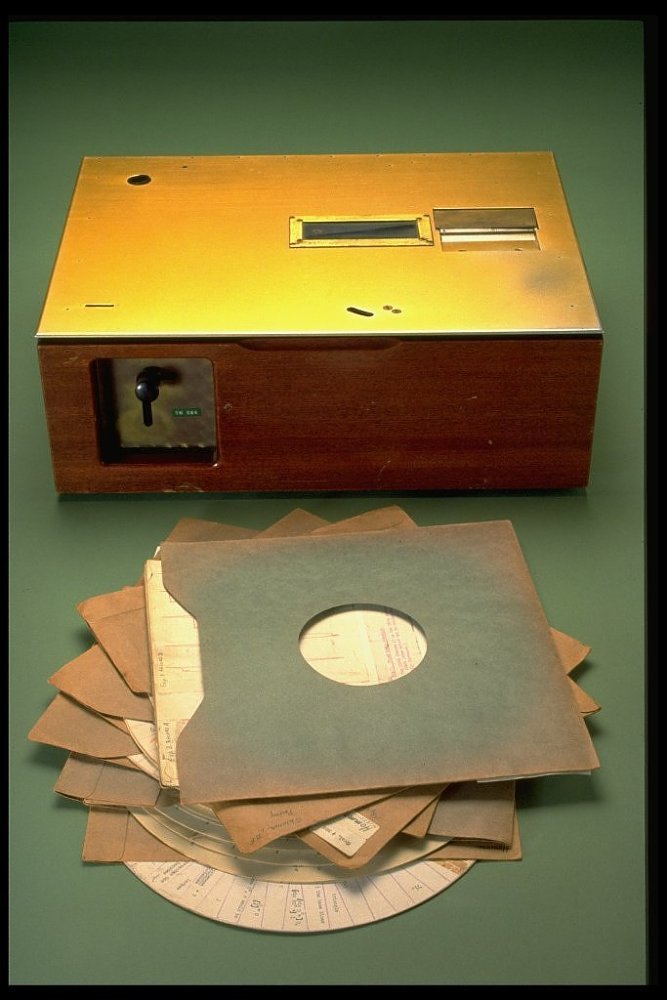
His yellow, wooden box contained a spindle for various rotating, paper discs. The questions were written along the radii of the discs and shown one by one in a window. The student had to write they answer on a roll of paper to the right of the questions in another aperture. When the student advanced the question, a model answer was seen, so the student could compare what they had written with the correct answer, without being able to change their answerThe learning was structured in a series of small steps. Hints and prompts maximise success and being right, so there is progress towards more complex knowledge. Skinner saw the machine as giving quick feedback, free from error, providing active learning and the fact that the student moves at their own pace was seen by him as a real benefit, whether faster or slower, at the rate most appropriate for that student. He claimed that this machine-based learning doubled the rate of learning, compared to the traditional classroom.

The content was carefully programmed to build, step by step towards synthesis and complex ideas. The machines then began to include more complex branching, with audio and screen presentations. Industrial and military applications focused on vocational learning. 

Learning theories

Pressey has very specific views on learning theory, more towards cognitive psychology than pure behaviourism. Errors or the correction of misconceptions were, for him, fundamental to learning, hence his fondness for multiple choice questions, which had 4/5 wrong answers. He saw learning as a complex process where relatively stable, cognitive structures had to be created. This had to be achieved through the analysis of errors, along with individualisation, diagnosis and feedback. Learning, for Pressey, was not a form of reinforcement, as with animals but involved uniquely human mediation through language, speaking, listening, reading and writing. It was a deeply cognitive process. He even formulated an early theory of Blended Learning, which he called, rather clumsily, ‘Adjunct Autoinstruction’. This involved the combination of programmed learning through technology and human teaching.

Plessy was the antithesis of Skinner, whose teaching machine was designed around positive reinforcement, hence his avoiding multiple choice questions, where the wrong answers (negative stimuli) outnumbered the right answer, that were actually given to the student, in advance of them having to think. Skinner saw this as weak learning and didn’t buy the idea that the study of wrong answers was anything but a distraction and, more seriously, seeding confusion in terms of what was learned.


Contemporary relevance


There are several lessons we can learn from this episode in the development of learning technology. First, that the cultural inertia in education is as strong today as it was then. Second, that learning technology, if it is to teach, must provide the presentation of material, cognitive interaction and feedback. Third, that marking is an area ripe for automation as it frees teachers to do more and better teaching. 

However the most important lessons lie around pedagogy. There is a serious debate around the nature of interaction and feedback, with one side still sticking to Pressey's multiple-choice questions and their variants versus Skinner's open input. AI is also being used to automatically create Skinner type content, along with AI identified links to the outside world. Open input (a feature of Skinner’s machine), and rarely applied even now in online learning, can now be interpreted using semantic analysis of open text answers. It requires more cognitive efforts with multiple choice questions, the answer is already given and you are selecting, rather than having to think deeply and recall. this was not coercion but a structured apron h to learning that puts the responsibility in the hand of the learner.

The advantages which automated, computer-based learning offer are much the same as they were 100 years ago, when Pressy built his first Teaching Machine. In fact, there is renewed interest in spaced, deliberate and retrieval practice, which have all shown significant learning gains, as well as learning in small steps (chunking). At its most advanced, adaptive learning systems resequence learning experiences to match the individual student’s progress. This optimises the path the student takes, based on individualised and aggregated data. Every learner learns uniquely. This keeps the student, on their learning journey, at the right level, neither pushing too far ahead nor making it too easy, both of which can destroy motivation and actual learning.

It turns out that both were correct. Pressey was right in seeing error correction with feedback a as powerful force in learning Metcalfe (2017). Skinner was right in seeing effortful learning, Brown (2014), as an important driver in learning. These were the germs of truth in their view that technology could significantly revolutionise learning, which has happened.

Influence

Pressey was convinced that education had to be reformed and called for an ‘industrial revolution’ in learning, based on the use of technology. He suffered a breakdown when his devices failed to sell and felt that the education system was closed to innovation. Skinner has similar frustrations. So by the 1960s mechanical teaching machines had had their day. As mechanical devices they were clunky and relied on discs, barrels, levers and buttons, all hardware and no software. They had little real effect on learning technology in the long-term, other than objects of obscure interest by commentators who perpetuate myths about Skinner’s Box being a Teaching Machine (it was not) and him hot housing his daughter (which he did not).

It is also a mistake to see these machines as being some sort of consequence of strict behaviourism. Pressey was more of a cognitive psychologist than behaviourist and Skinner's design had open input by the students, something few systems have to this day, hardly a primitive stimulus-response. Behaviourism was more than Skinner. In the long-term, Tolman's latent learning, along with Thorndike's work on transfer have stood the test of time. They were all much more sophisticated that their recent critics suggest.

In truth it was Babbage’s calculating machine in 1882 that was the real breakthrough, paving the way for computers and computer based learning. It was computers that were to provide the hardware and more importantly, the flexibility of software, logic and media presentation abilities that form the real evolutionary path for technology based learning. The 1970s saw the real rise of the personal computer and real teaching machines, with real software. The other great technological developments were in media; mass produced radios and television happened at the same time in the 50s. It was this confluence of hardware and software that created teaching machines that really were manufactured, sold and eventually became the desktops, laptops, tablets and smartphones, bought by billions of consumers on a global scale, using that global network - the internet.

Having worked for many years in an adaptive learning company, that specialised in personalised learning, I can scotch the idea that these machines ever influenced the vision or design of personalised learning. No one ever made reference to Pressey or Skinner. I doubt that anyone, apart from myself, even knew of the existence of these mechanical machines.

Bibliography

Slater, L., 2005. Opening Skinner's box: Great psychological experiments of the twentieth century. WW Norton & Company.
Benjamin, L. T. (1988). A history of teaching machines. American Psychologist, 43(9), 703–712. https://doi.org/10.1037/0003-066X.43.9.703
Mellan, I., 1936. Teaching and educational inventions. The Journal of Experimental Education4(3), pp.291-300.
Petrina, S., 2004. Sidney Pressey and the automation of education, 1924-1934. Technology and Culture, 45(2), pp.305-330.
Ferster, B., 2014. Teaching machines: Learning from the intersection of education and technology. JHU Press.
Metcalfe, J., 2017. Learning from errors. Annual review of psychology68, pp.465-489.
Brown, P.C., 2014. Make it stick. Harvard University Press.
https://www.youtube.com/watch?v=CFYruzWeFwQ General summary of Teaching Machines
https://www.youtube.com/watch?v=GXHmFZyKEVY Skinner on his Teach Machine

Friday, June 14, 2024

The 'Netflix of AI' that makes you a movie Director

Film and video production is big business. Movies are still going strong, Netflix, Prime, Disney, Apple and others have created a renaissance in Television. Box sets are the new movies. Social media has also embraced video with the meteoric rise of Tik Tok, Instagram, Facebook shorts and so on. YouTube is now an entertainment channel.

Similarly in learning. Video is everywhere. But it is still relatively time consuming and expensive to produce. Cut to AI…

We are on the lip of a revolution in video production. As part of a video production company then using Laserdiscs with video in interactive simulations, I used make corporate videos and interactive video simulations in the 80s/90s. The camera alone cost £35k, a full crew had to be hired, voiceovers in a professional studio (eventualy built our own in our basement), an edit suite in London. We even made a full feature film The Killer Tongue (don’t ask!).

With glimpses and demos of generated video, we are now seeing it move faster into full production, unsurprisingly from the US, where they have embraced AI and are applying it faster than any other nation.

1. Video animating an Image or prompt

I first started playing around with AI generated video from stills and it was pretty good. It’s now very good. Here’s a few examples. 

Now just type in a few words and it's done.

Turned this painting of my dog into a real dog...

Made skull turn towards viewer...


Pretty good so far...

2. Video from a Prompt

Then came prompted video, from text only. This got really good, really fast, with Sora and new players entering the market such as Luna.


Great for short video but no real long-form capability. In learning these short one-scene videos could be useful for performance support and single tasks or brief processes, even triger video as patients, customer, employees and so on. This is already happening with avatar production.

3. Netflix of AI

Meet Showrunner, where you can create your own show. Remember the Southpark episode created from AI? Same company has launched 10 shows where you can create your own episodes.

Showrunner released two episodes of Exit Valley, a Silicon Valley satire starring iconic figures like Musk, Zuck and Sam Altman. The show is an animated comedy targeting 22 episodes in its first season, some made by their own studio, the rest made by users and selected by a jury of filmmakers and creatives. The other shows, like Ikiru Shinu and Shadows over Shinjuku, are set in Neo-Tokyo, are set in distinct anime worlds, and will be available later this year.

They are using LLMs, as well as custom state-of-the art diffusion models, but what makes this different is the use of multi-agent simulation. Agents (we’ve been using these in learning projects) can build story progression and behavioural control.

This gives us a glimpse of what will be possible in learning. Tools such as these will be able to create any form of instructional video and drama, as it will be a ‘guided’ process, with the best writing, direction and editing built into the process. You are driving the creative car but there will be a ton of AI in the engine and self-driving features that allows the tricky stuff to be done to a high standard behind the scenes. Learners may even be able to create or ask for this stuff through nothing more than text requests, even spoken as you create your movie.

The AI uses character history, goals and emotions, simulation events and localities to generate scenes and image assets that are coherent and consistent with the existing story world. There is also behavioural control over agents, their actions and intentions, also in interactive conversations. The user's expectations and intentions are formed then funneled into a simple prompt to kick off the generation process.

You may think this is easy but the ‘slot-machine effect’, where things become too disjoined and random to be seen as a story, is a really difficult problem. So long-term goals and arcs are used to guide the process. Behind the scenes there is also a hidden ‘trial and error’ process, so that you do not see the misfires, wrong edits etc. The researchers likened this to Kahneman’s System 1 v System 2 thinking. Most LLM and diffusion models play to fast, quick, System 1 responses to prompts. For long-form media, you need System 2 thinking, so that more complex intentions, goals, coherence and consistency are given precedence.

Interestingly hallucinations can introduce created uncertainty, a positive thing, as happy accidents seem to be part of the creative process, as long as it does not lead to implausible outcomes. This is interesting – how to create non-deterministic creative works that are predictable but exciting, novel works.


This is what I meant by a POSTCREATION world, where creativity is not a simple sampling or remixing but a process of re-creation.

4. Live action videos

The next step, and we are surely on that Yellow Brick Road is to create your own live action movies from text and image prompts. Just prompt it with 10 to 15 words and you can generate scenes and episodes from 2 - 16 minutes. This includes AI dialogue, voice, editing, different shot types, consistent characters and story development. You can take it to another level by editing the episodes’ scripts, shots, voices and remaking episodes. We can all be live-action movie Directors.

Conclusion

With LLMs, in the beginning was the ‘word’, then image generation, audio generation, then short form video, now full-form creative storytelling. Using the strengths of the simulation, co-creating with the user, and the AI model, rich, interactive, and engaging storytelling experience are possible.

This is a good example of how AI has opened up a broad front attracting investment, innovation and entrepreneurship. At its hear are generative techniques but there are also lots of other approaches that form an ensemble of orchestrated approaches to solve problems.

You have probably already asked the question. Does it actually need us? Will wonderful, novel creative movies emerge without any human intervention. Some would say ‘I fear so’. I say ‘bring it on’. 


Wednesday, May 15, 2024

Google just dropped some great news on AI for learning....

OpenAI drummed up a great PR campaign with leaks around the movie ‘Her’ and Altman hints. What many missed was another launch by Google. That’s how fast this stuff moves.

More than this they published a paper we in the learning game should all read. Towards Responsible Development of Generative AI for Education: An Evaluation-Driven Approach. It has 75 authors!

What the paper does is address a BIG issue – getting learning insights into GenAI.

Excitement is brewing over the potential of GenAI to revolutionise learning by providing a personal tutor for every student and a teaching assistant for every teacher. The OpenAI launch was fantastic and showed real opportunities and promise. They out Appled Apple with their focus on user experience and functionality.

However, this vision is still not reality, mainly due to the complexity of translating learning insights into effective AI prompts and the lack of robust ways to measure AI's teaching effectiveness. SO Google teamed up with learners and educators to turn broad educational theories into practical evaluation benchmarks. This is a mix of quantitative and qualitative measures, both automated and human-led, and they have developed new training datasets to enhance the educational skills of their GenAI system, LearnLM-Tutor. 

They claim to be achieving  great results from LearnLM-Tutor over other models because of its superior teaching abilities. They would say that, wouldn’t they. But I’m impressed, as this work lays the groundwork for a comprehensive framework to assess educational AI, potentially accelerating GenAI's positive impact on learning.

What this report does is look at the use of GenAI to enhance education through AI-driven tutoring, particularly focusing on conversational models. Their approach utilises Supervised Fine-Tuning (SFT) with data informed by educational principles, improving the AI tutor, LearnLM-Tutor, beyond the Gemini 1.0 model. 

They are honest about the challenges, especially in defining and achieving true pedagogical mastery with AI. Collecting a diverse range of high-quality pedagogical data is costly and labour-intensive, and it is unclear how many examples are necessary to comprehensively cover pedagogical behaviours.


So they have  established a set of benchmarks to evaluate their progress, although these too have their limitations—especially the expensive nature of human evaluations. To address these issues, they have put together a  multidisciplinary team, including AI scientists, engineers, pedagogical experts, and cognitive scientists, to work on refining these evaluation methods. This collaborative effort aims to not only enhance the current AI models but also invites the broader AI and learning science communities to join in enhancing and utilising these pedagogical benchmarks. Their ultimate goal is to leverage AI effectively to benefit learners, pushing forward the boundaries of learning technology. More power tyo their elbow.

Google is Google. They don’t do product launches like OpenAI, they integrate things into their world. They have a global view of technology, which means integrated. Don’t write them off.


Sunday, January 22, 2023

OpenAI has opened up AI to the world but will it conquer the world?

We have been using GPT software since its launch in a range of learning tasks and in all three of these books, the idea of AI generating content among many other tasks is covered. It is not a matter of 'if' but when and how much the learning game will be transformed by AI.

AI is the new UI, as well as generating content, learner support, personalisation and assessment. It is leading to smarter platforms, smarter content and smarter forms of delivery.

OpenAI is worth around $30 billion. This doesn’t surprise me. It was set up as a philanthropic entity to create AI for the good of humankind. It has been true to that goal so far, creating some of the most astounding AI services we’ve ever seen. It worked because of its focus on hiring some of the best talent on the planet, funding it well and giving them clear goals.


It started with a $1 Billion investment in December 2015 by Elon Musk, Sam Altman, Greg Brockman, Jessica Livingston, Peter Thiel, Reid Hoffman, AWS, Infosys and YCResearch. It became a ‘capped-for=profit with a $1 Billion investment by Microsoft.


1. Microsoft has invested $1 billion but that deal is not exclusive, so OpenAI can do things for themselves and with others. This gives them the flexibility to do things either solo or in deals with others.


2. DALL-E became a global meme in image creation. It was the start of generative image AI that is going at an incredible speed. It is clear that this will have a major impact on image production, content production, even art. There is also Image GPT.


3. GPT-3 (Generative Pre-trained Transformer) is much larger than ChatGPT, with 175 billion parameters compared to ChatGPT's 20 billion parameters. This makes GPT-3 more powerful and capable of handling more complex natural language processing tasks.


4. ChatGPT-3 though, is a dialogue based LLM that was released to huge acclaim. It is truly disruptive as a text generator in areas such as content creation and assessment. It is rumoured that ChatGPT-4 will be released in 2023.


5. Whisper is speech recognition software, trained on a huge and diverse set of audio data. It can generate speech as well as translate and identify languages. 


6. OpenAI Five is a set of five bots that play on five on five games in Dota 2, a computer game. They also have GYM Retroa platform for RL research on video games. 


7. MuseNet has been trained to predict subsequent musical notes in MIDI music files to generate songs with ten different instruments in fifteen different styles.


In just a few years they have managed to create some of the world’s most advanced AI software. There is no guarantee that the existing large tech companies will not be challenged by the new. In fact, it is almost certain. Being small and focussed, well funded, with clear goals, can lead to stunning breakthroughs. Deepmind was a previous example in AI, there will be others.

Friday, December 20, 2024

AGI is here...


As easy as one-two-three? No. Easy as one-three. OpenAI has skipped o2 to call their new ‘frontier’ model o3 (Altman hinted that this may have been due to Telco o2 issue). I like the idea that AI is undermining everything we were told makes good marketing - no read branding, messaging, just get it out there with benchmarks.

Social media was full of people saying Google had destroyed OpenAI. But their pre-Christmas release single was smashed off the Charts by OpenAI’s o3.

Transcending human intelligence

Not sure we've realised that we now have AGI. Arc-AGI solved with 87.7% (human threshold 85%) as well as other benchmarks... we will, of course, move the bar higher, find ways to avoid recognising the achievement... then pass it again... Arc Prize is a not-for-profit with an AGI benchmark. There are new skills so that the AI cannot memorise them.  

To give you some idea of the speed and scale of progress:

Software engineering

On real-world software tasks, evaluations on o3 are more than 20% better than o1 models at 71%. AI has already established itself as solid, useful and widely used coding tool. People have been letting AI code then iterating  iterate. This takes it to another level. One wonders how long the job of coder will survive at this rate.

Maths and science

Also superb at maths and PhD science questions at 88.7 %. A typical PhD gets around 70%. Frontier is toughest mathematical dataset – extremely hard problems. o3 has 25% accuracy which is a strong result.

GPQA Diamond

An interesting measure of how far we have come is GPQA Diamond. It's a clever test that compares a model against npvice Google search, human domain experts and the model. Experts get 81% right in their fields, highly skilled non-experts with 30 minutes per question and Google access get 22%. GPT-4 got 37% at the start of 2024. o1 got 78%. o3 is 87.7%. That is astonishing.

AGI

Artificial General Intelligence suffers from a problem of definition, as do most abstractions at this level. Does it mean:

Specific human reasoning skills (maths, science etc)

Average human competences

Greater than all of humanity

There is no singularity, there is a spectrum or constellation of possible targets here. What is clear is that these targets are being hit, not in one go, but one by one, sometimes in clusters. Maths and science are easy to measure but also fiendishly difficult to achieve, so this is a real milestone. Yet they focus on clear rationality. To be fair critics were telling us that AI would never get here, never mind get here so fast. We should celebrate this as many of the problems we face with climate, energy, healthcare and education may well be solved, not in the sense of final solutions but better solutions.

Problem solving in real life is messier and more of a challenge. That's why the agentic move is so interesting, as it tackles this set of human capabilities. We have brains that have evolved into a specific environment where we had to solve specific problems. This is where the dynmaic interrogative, dialogic nature of AI helps enormously. It has already made great strides in this direction.

Embodied AI, in the physical world of elevators, cars, cabs, trucks, drones, ships and submersibles has also taken great leaps. This is another set of targets that are being hit one by one. One could argue that neurological targets are also on our hotlist - Neuralink is a good example, where we enhance our neurological deficits.

AI may help us understand neuroscience and the brain, solve engineering problems to accelerate fusion, help with drug discovery and many other intractable problems. What we can be sure of is the increased impact of AI on productivity. The leaps in efficacy prove this.

Conclusion

This is a warning to people who claim that scaling is over. Sutskever was right – we have a way to go and other techniques are clearly delivering the goods. It is clear that AI is delivering faster than expected. The consequences of AGI are closer than expected with huge productivity gains on the horizon. That is the subject of the book I am currently writing.

Future issues

One issue needs discussion - compute costs. I think this will be solved. We saw a 250x decline in token costs in 20 months. So $20 for hard problems are likely to come down to cents.

One can now start to ask how the cost of compute compares to human costs in organisations for similar tasks and roles. The productivity game looks as though it will start with coding, where much of it can be automated.

On problems to solve:

  • fusion
  • medical research
  • personalised tutors
  • optimising political policies
  • next-generation batteries
  • cheap renewables

A final though on AI being self-generative. At what point does this technology start working on itself to solve the frontier problems and advance even quicker?